
Grindrod has announced the official opening of United Container Depots’ new facility in Salt River, Cape Town, located less than three kilometres from the Port of Cape Town. UCD, a wholly owned subsidiary of Grindrod, has established the depot to strengthen the company’s national footprint and position Cape Town as a growing global trade gateway.
Facility Specifications and Capabilities
The new depot provides capacity for 5,000 twenty-foot equivalent units, alongside 240 reefer plugs and on-site refrigerated container preparation facilities. The facility is rail-linked to the port, with Phase 2 development planned to introduce private rail sidings. The depot is designed to support South Africa’s critical exports, including citrus and grapes, addressing the specialised requirements of temperature-controlled agricultural exports.
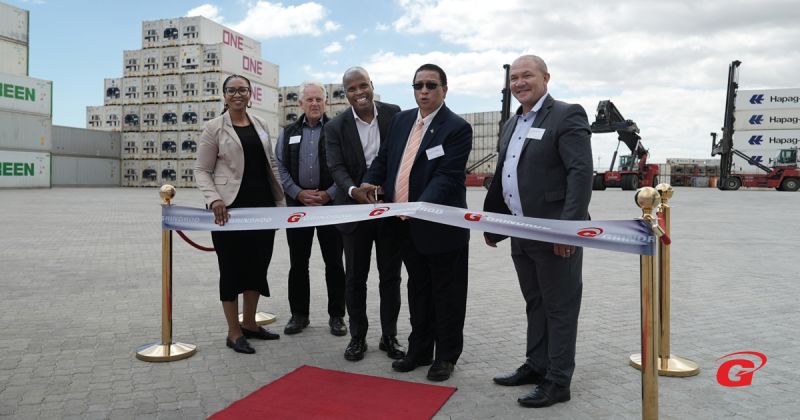
From Left: Ms Noxolo Thabatha, terminal manager of the Cape Town Container Terminal; Glen Steyn, director: Maritime Logistics Development, Department of Economic Development and Tourism, Mr Xolani Mbambo, CEO of Grindrod Limited, The Honourable Dr Ivan Meyer, provincial minister of Agriculture, Economic Development and Tourism, Richard de Doncker, terminal manager of UCD in Cape Town
Strategic Significance
At the opening ceremony, Grindrod Chief Executive Officer Xolani Mbambo emphasised that the development represents more than infrastructure provision. He stated, “We are not just opening a depot; we are opening opportunities for exporters, importers, farmers, manufacturers, and communities.”
Dr Ivan Meyer, Provincial Minister of Agriculture and Economic Development and Tourism, highlighted alignment with the Western Cape’s Growth for Jobs Strategy, which aims to create 220,000 new jobs by 2035 and triple exports to R450 billion. The depot supports these economic development objectives through enhanced logistics infrastructure serving the region’s export industries.
Operational Advantages and Export Support
The depot’s proximity to the Port of Cape Town provides logistical efficiency for container movements between port terminals and inland preparation facilities. This proximity reduces transport costs and transit times whilst enabling rapid turnaround of equipment serving export cargo flows.
Refrigerated container capacity proves particularly significant for Western Cape agricultural exports, where citrus, grapes, and other perishable products require temperature-controlled supply chains from packing through ocean transport. On-site reefer preparation capabilities enable inspection, cleaning, pre-cooling, and verification of refrigeration systems before loading export cargo, ensuring product quality during ocean transit.
Rail Connectivity and Future Development
Rail linkage to the port supports efficient container movements at scale, providing alternatives to road haulage whilst potentially reducing congestion and logistics costs. The planned Phase 2 development introducing private rail sidings will enhance operational flexibility and capacity for rail-based cargo movements.
Private sidings enable direct rail service to the depot without reliance solely on public rail infrastructure, potentially improving service reliability and operational control. This infrastructure supports modal shift objectives, encouraging greater use of rail for container movements between ports and inland facilities.
Regional Economic Context
The Western Cape produces substantial volumes of agricultural exports destined for international markets, with fresh fruit exports representing significant economic activity and employment. Efficient logistics infrastructure proves essential for maintaining product quality, competitive delivery times, and cost-effectiveness, supporting the region’s export competitiveness.
Cape Town’s position as a maritime gateway for South African exports requires supporting inland infrastructure, including container depots, cold storage facilities, and transport connections. The UCD Salt River depot enhances this infrastructure ecosystem serving exporters and importers utilising Cape Town port facilities.
Stakeholder Collaboration
Grindrod acknowledged contributions from customers, government partners, Transnet (South Africa’s state-owned ports and rail operator), and Grindrod and UCD teams who participated in the opening ceremony. The development reflects public-private collaboration supporting logistics infrastructure development aligned with regional economic development strategies.
The facility opening strengthens Grindrod’s container depot network serving South African ports and export industries, complementing UCD’s existing facilities in other major port cities. The national footprint enables comprehensive service offering for customers requiring container handling, storage, and preparation services across multiple locations.
For more information visit www.grindrod.com
17 October 2025