
ITCO survey shows that tank container demand remains robust
ITCO’s Annual Tank Container fleet survey is eagerly awaited by industry watchers as it is an independent source of hard statistics on the tank container sector.
As this year’s survey is still relatively fresh, it is worth drilling down into the data to capture a view of the state of the global tank container industry.
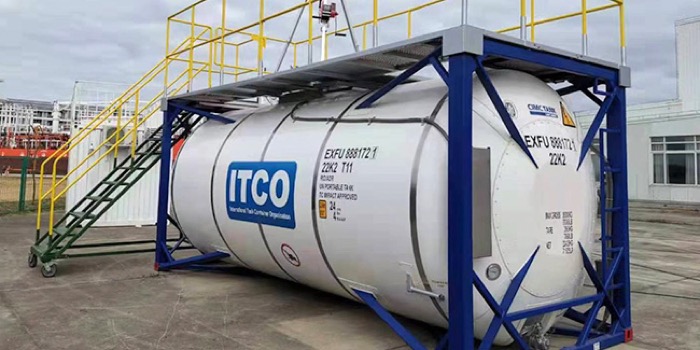
What is immediately evident from the latest survey is a rebound in the growth of the global tank fleet.
In 2021, the fleet increased by 7.3 percent to 737,935 units. This compares with a growth of 5.26 percent during 2020. The relative slowdown during the prior year was almost certainly due to the uncertainty caused by the Covid-19 pandemic, as well as the difficulty of assembling shift workers in the major tank manufacturing centres, principally China, thanks to harsh lockdowns.
However, even from the earliest days of the pandemic it was clear that demand for tanks remained strong; not least to ship vastly increased volumes of raw materials for hand sanitisers.
During the following year – 2021 – Covid restrictions began to ease and so manufacturers were able to resume production and meet the build up of demand for new equipment.
More than 53,300 new tanks were built during 2021, the third highest output since the survey began some 10 or so years ago. This is in stark contrast to 2020 when just 35,800 were built, the lowest production figure over the lifetime of the ITCO survey.
Most of the major tank manufacturers saw big increases in output. China’s CIMC Safeway, which dominates the global market, built over 60 percent more tanks in 2021 than in the previous year, turning out 29,525. The second largest builder, NT Tank, raised its output from 6,000 in 2020 to 9,000 in 2021, while South African company Welfit Oddy almost doubled its output to 4,000 units.
Since the global economy started to rebound from the pandemic-induced slowdown, there has been a scramble to find slots on container vessels, and consequently container shipping rates have soared.
Just recently, one data provider said that long-term contractual shipping costs in May 2022 were 150 percent higher than the same time a year ago. This has proved both a challenge and an opportunity for the tank container industry.
ITCO notes in the latest survey that containership capacity shortages from Asia to the main markets of North America and Europe have indeed led to extremely high freight rates.
Despite these rate increases demand for tanks has kept growing.
ITCO notes that the high freight rates put greater pressure on shippers to maximise the quantity of cargo shipped within each ISO container slot, and as a tank container can move about 60 percent more cargo when compared with a standard dry container packed with, say, drums, the tank is proving even more popular.
The global tank leasing fleet rose by some 6,000 units to 322,950 at the end of 2021.
The 10 largest leasing companies accounted for about 85 percent (275,050 tanks) of this total leasing fleet, which represents an increase in concentration from the previous year’s survey when this stood at 79.5 percent.
But most of this rise in concentration was down to the acquisition of the Gem Container fleet by MRI Intermodal client Peacock Container in April 2021, which resulted in a more than doubling of Peacock’s total fleet from 7,500 to 17,500 units.
Other tank leasing companies which added significant numbers of equipment to their fleets during 2021 include the biggest of them all, USA-headquartered EXSIF Worldwide. EXSIF’s total fleet grew from 66,476 tanks to 71,350.
Also very active during 2021 was CS Leasing. CS is a relative newcomer to the tank leasing sector having been established in 2015 as a special container unit of dry freight container leaser CARU. CS Leasing’s fleet expanded from 18,030 to 23,450, propelling it into the position of the fourth largest leaser.
Singapore-based Raffles Lease saw its fleet reach 20,500 units by January 2022, up from 16,000 at the same point a year earlier.
The tank container operator sector is much more diversified than either the leasing or manufacturing parts of the industry, with the 10 biggest operators accounting for around 55 percent of the global fleet.
In 2021, these 10 bigger operators had just over 20,000 more units in their combined fleet of (266,665) than in the prior year.
A notable change in this year’s top 10 operators is the addition of MRI Intermodal client Suttons Group, headquartered in the UK. Suttons’ fleet jumped from 9,500 to 14,115 units during 2021. This was largely due to Suttons reaching an agreement to acquire the overseas tank containers and customer contracts of Hamburg-based VTG. But the UK group is also expanding organically; most recently the company announced it is adding 100 further units to its fleet as part of an expansion plan.
Other MRI Intermodal clients that added more tanks to their fleets last year were UK-based M&S Logistics (from 8,443 to 9,365 units), and Singapore firm Eagletainer (up from 10,500 to 12,000). These might not be big volume numbers compared with the operator sector giants, but proportionately they represented fleet growth of 10 percent and 14 percent, respectively.
Finally, the ITCO survey notes an interesting development; a small, but detectable growth in the number of tanks owned by shippers and beneficial cargo owners (BCOs).
It is especially difficult to compile a list of shipper-owned tanks, because such ownership is a relatively small part of their core business and – as a result – fleet figures are not freely available. This also applies to other tank users, such as shipping lines, military authorities, railways, oil companies, mining firms and domestic Chinese operators.
Yet, despite the general trend to outsourcing tank logistics, the shipper and ‘other’ fleet is getting bigger. By the start of 2022 this figure had reached 211,285, up from 199,140 a year earlier, and almost double the estimated fleet size in 2015.
It is estimated that on average about 35 percent of the total leasing company fleet is leased directly to shippers and others, rather than operators.
For more information visit www.international-tank-container.org
3rd October 2022