

Volvo to launch hydrogen-powered trucks
Volvo Trucks is making significant strides towards decarbonising heavy transport by developing trucks with combustion engines that run on hydrogen. On-road tests for these hydrogen-powered trucks will commence in 2026, with a commercial launch planned towards the end of the decade. This development is a crucial step for Volvo to achieve its net-zero goal and support customers in reaching their decarbonisation targets.
The introduction of trucks running on green hydrogen instead of fossil fuels marks a major advancement in decarbonising transport. These hydrogen trucks will be particularly suitable for longer distances and in regions where charging infrastructure is limited or where there is insufficient time for battery recharging.
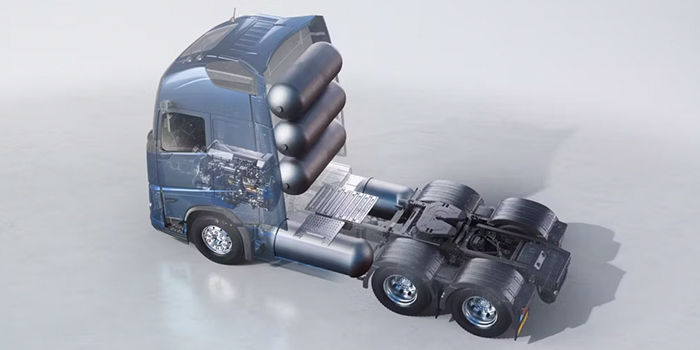 Volvo will launch trucks with combustion engines that can run on green hydrogen. These trucks provide a significant step to decarbonising heavy transport
Volvo will begin customer tests with hydrogen-powered combustion engine trucks in 2026, and these trucks will be commercially available towards the end of the decade. Laboratory and vehicle testing is already underway. The hydrogen-powered combustion engine trucks will complement Volvo’s existing range of alternatives, including battery electric trucks, fuel cell electric trucks, and trucks running on renewable fuels such as biogas and Hydrotreated Vegetable Oil.
“Trucks where the traditional internal combustion engine remains but runs on hydrogen will have the same performance and reliability as our diesel trucks, but with the added benefit of potentially net zero CO2 emissions well-to-wheel. They will be a valuable complement to our battery electric trucks, which have been on the market for several years,” says Jan Hjelmgren, Head of Product Management and Quality at Volvo Trucks.
Volvo trucks with combustion engines powered by green hydrogen have the potential to deliver net zero CO2 emissions well-to-wheel when using renewable HVO as ignition fuel. These trucks are categorised as “Zero Emission Vehicles” under the new EU CO2 emission standards.
“It’s clear that several kinds of technology are needed to decarbonise heavy transport. As a global truck manufacturer, we need to support our customers by offering a variety of decarbonisation solutions, and customers can choose their alternative based on transport assignment, available infrastructure, and green energy prices,” says Hjelmgren.
The hydrogen-powered combustion engines in Volvo trucks will feature High Pressure Direct Injection (HPDI) technology. This technology involves injecting a small amount of ignition fuel at high pressure to enable compression ignition before adding hydrogen. The advantages of HPDI include higher energy efficiency, lower fuel consumption, and increased engine power.
Volvo Group has signed an agreement with Westport Fuel Systems to establish a joint venture utilizing HPDI technology. This joint venture is anticipated to become operational in the second quarter of 2024, following the formal closing.
Key Facts
- Hydrogen-powered Volvo trucks will have an operational range comparable to many diesel trucks, depending on the type of transport.
- Due to the low CO2 emissions from hydrogen combustion, these trucks are categorized as “Zero Emission Vehicles” under the new EU CO2 emission standards.
- Hydrogen combustion engines will emit very small amounts of nitrogen oxides and particles.
- Hydrogen can also be used to power fuel cell electric trucks, where electricity is produced on board the truck. Fuel cell electric trucks do not emit any tailpipe emissions, only water vapor.
This innovative move by Volvo Trucks highlights the company’s commitment to providing diverse and sustainable transportation solutions, reinforcing its role as a leader in the global effort to decarbonise the transport sector.
For more information visit www.volvotrucks.com
27 May 2024