
World’s first liquefied CO2 carrier equipped with Wind Challenger – AiP obtained for a three unit’s design
Mitsui O.S.K. Lines, Ltd. (MOL) has obtained Approval in Principle (AiP) from classification society Nippon Kaiji Kyokai (ClassNK) for a liquefied CO2 carrier equipped with three units of Wind Challenger, a hard sail wind-assisted propulsion system. The approval was granted on April 14, 2026, with the AiP Award Ceremony held on April 22, 2026, at the ClassNK booth during Sea Japan 2026 at Tokyo Big Sight.
The vessel design was jointly developed with Samsung Heavy Industries Co., Ltd. (SHI), headquartered in Seoul, Republic of Korea, and is intended to reduce fuel consumption and greenhouse gas (GHG) emissions by harnessing wind power for the cross-border transportation of liquefied CO2.
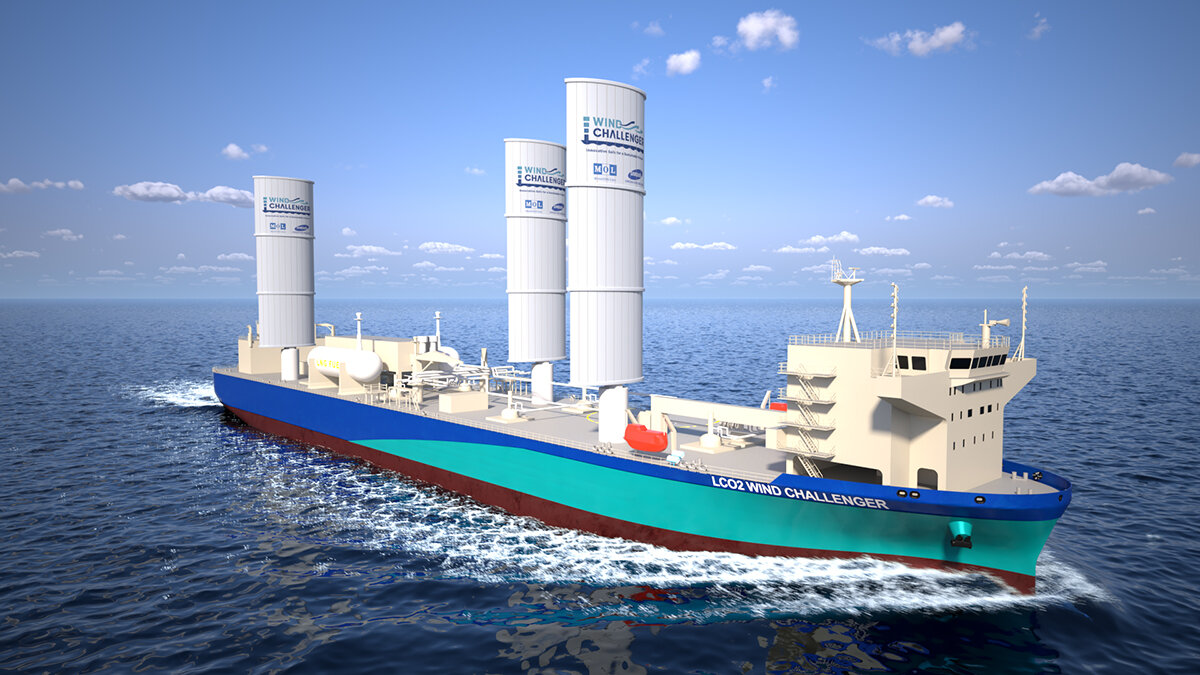 CG rendering of a liquefied CO2 carrier equipped with three Wind Challenger units
The approved design covers a liquefied CO2 carrier with a 40,000 m3 cargo tank capacity. In a notable structural feature, the navigation bridge and accommodation spaces are positioned toward the bow to ensure improved visibility for ship handling while accommodating the installation of all three Wind Challenger units. The design also incorporates a range of safety measures, including a dedicated safety passage between the engine room and accommodation spaces, optimised navigation light arrangements, and strategic lifeboat placement.
MOL worked closely with SHI and ClassNK to conduct a Hazard Identification Study (HAZID), identifying and assessing risks specific to liquefied CO2 carriers fitted with wind-assisted propulsion systems. The exercise confirmed both the technical feasibility and safety of the vessel concept.
Wind Challenger is a rigid sail system capable of automatic extension, retraction, and rotation. By effectively harnessing wind power during navigation, the technology contributes to reductions in fuel consumption and GHG emissions. Its application to liquefied CO2 carriers is expected to lower emissions generated during the CO2 transportation phase of the Carbon Capture and Storage (CCS) value chain, further mitigating the vessel’s environmental impact.
The development aligns with MOL Group’s broader decarbonisation ambitions. The company has set a target of achieving net zero GHG emissions by 2050 under its Environmental Vision,BLUE ACTION 2035 Phase 2, and plans to expand its Wind Challenger-equipped fleet to 25 vessels by 2030 and 80 vessels by 2035. To date, three such vessels have been delivered, with installation confirmed across a total of eight vessels, including two LNG carriers scheduled for delivery in 2026.
MOL said the development of this liquefied CO2 carrier concept represents a meaningful step toward achieving both societal decarbonisation through CCS and ongoing reductions in its fleet’s fuel consumption and GHG emissions. The company said it will continue advancing wind-assisted propulsion technologies and contributing to broader CO2 emission reductions through the safe management and efficient operation of its environmentally friendly fleet.
For more information visit www.mol.co.jp
29 April 2026